Thursday, 10 November 2016

EDGE LIGHTING EFFECT


Edge lighting is where a subject has their silhouette emphasised with the use of back lighting. This is often used to exaggerate the outline of a person or to create mystery. It is most often used in promotional media, to make a subject seem godlike, in advertisements for sports most commonly.


REMBRANDT EFFECT


The rembrandt lighting effect is achieved by situating the key light at eye level, off to the side, pointing diagonally at the face of the subject. This creates a shadow on one side resulting in a triangle  of light below the eye. It is so named due to the fact that rembrandt's paintings would have this effect.

Friday, 4 November 2016

SHOT TYPES

SHOT TYPES from Willow Collins on Vimeo.

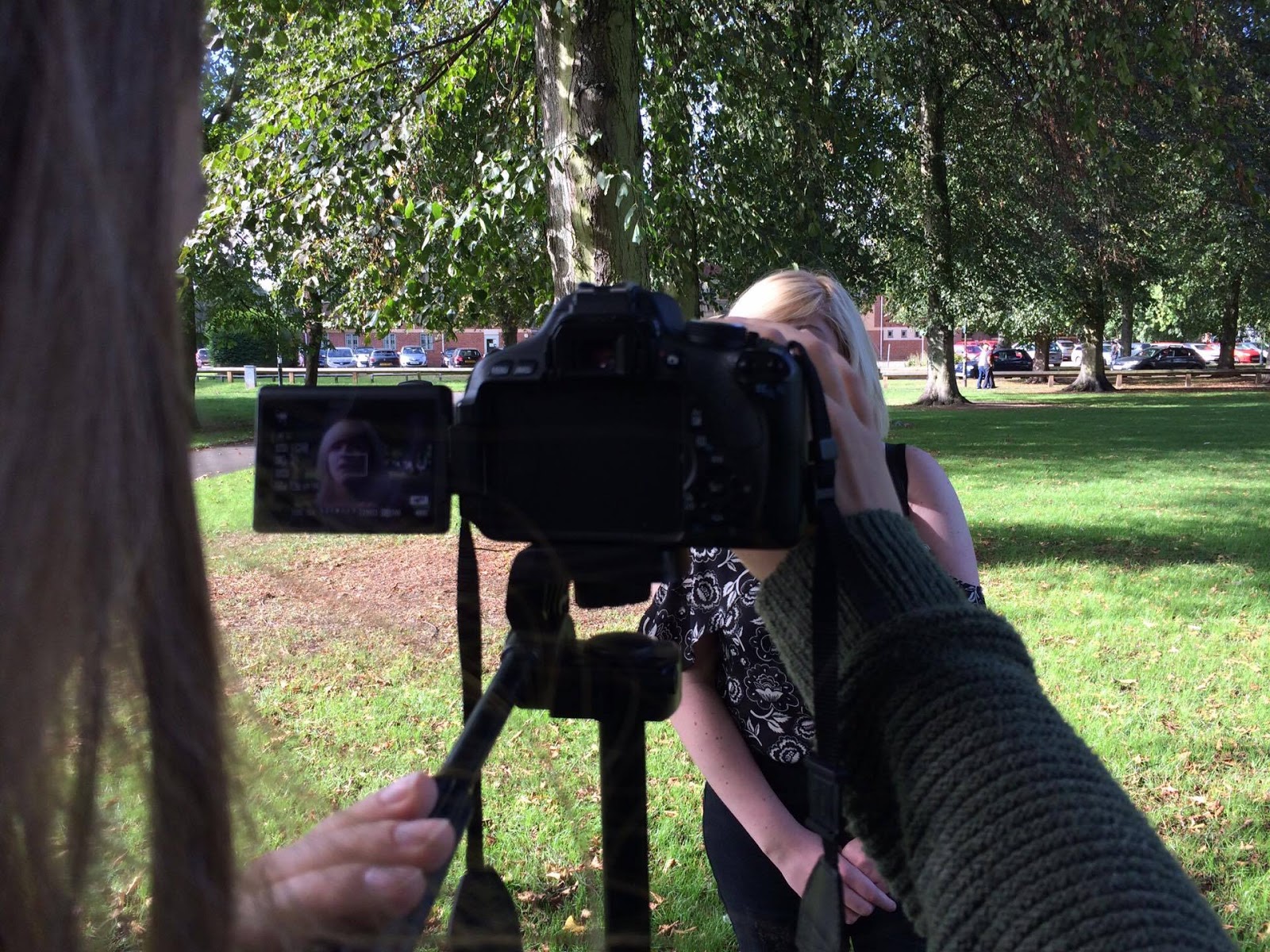
This shows the different camera techniques we've learned and applied this year so far. These clips accurately demonstrate how I managed to apply these well in a short period of time, and with limited resources or subjects. If I were to do it again, I would give myself more time so that i coul dfigure out how to do the dolly zoom, as you can see i didn't include it, becase we weren't able to figure out how to do it. I would also keep the tracking shot going a little longer, as i don't think i was able to create a real tracking effect due to us being a bit rushed for time. I've included photos of the shoot to show how we set up the cameras and positioned the subjects so as to get a good level of exposure in the images.


EDITING TYPES


Editing types from Willow Collins on Vimeo.

My editing types video includes an establishing shot, shot, reverse shot, 180 degree rule, 30 degree rule, parallel editing, match on action and the Kulescher Effect.

Establishing shot shows an environment or time, shot reverse shot establishes peoples position in a conversation. The 180 and 30 degree rule display variations in surroundings so as to keep a conversation between to people from becoming boring, with the exception to the 30 degree rule which has a smaller moving distance in terms of where you can film relative to the subject. Parallel editing gives a sense of time and match on action creates continuity in a scene. The kulescher effect is a way of portraying a subject in two different ways with the same footage. 

My footage i found to be quite confusing, i had to use some footage for the wrong effect as i did not gather enough. This is shown in my 180/30 degree rule clips, they both appear the same because they essentially are. Luckily, i had video evidence from films to demonstrate the effect more clearly. 

Sunday, 30 October 2016

NEW WAVE EVALUATION

My new wave film is essentially a montage of shots, edited to coincide with music. The main theme was movement and transport, specifically centring around trains. I achieved this by including an erratic and constantly changing editing style, incorporated with camera shots that would move in unusual ways, and different speeds. By making sure all the shots were filmed in this way, I hardly had to spend any time on the editing, as the movements worked well with each other. 

My initial plan was to simply have creative shots of the trains in coventry and the urban environment that surrounded it, but after i'd finished editing, I decided it would be a good idea to duplicate my new wave film, except have it in an old fashioned style, and place it alongside my initial edit. This basically created a comparison of transport, new and old, and gave me an opportunity to experience the role of a director of photography, since i had a list of shots that needed to be taken, so it would match the initial edit. 

A technique I used frequently was the choppy editing found in Breathless. In Breathless, there's a montage of shots of the female lead in a car with a voice over narrator. These shots, so as to convey the passing of time are staggered and mixed up to create a jumbled up effect. This influenced my montage heavily and made for a great effect on some of my longer, slower moving shots, however I feel as though the editing could have been more concise, so that it moved perfectly in line with the visuals.

Tuesday, 18 October 2016

PULL FOCUS

Pull focus from Willow Collins on Vimeo.


I feel the first shot went well, by using leaves i could easily switch focus between the ones closer and further away. I had to use the warp stabiliser for this which wasn't too bad, i was worried you wouldn't se the full effect of the pull focus but it turned out okay. If i were to do it again i would bring a tripod, as using handheld made this difficult. 

The water shot was less effective, i thought i could make the camera focus between the water and the wood around it, but the subjects were too close together to make any real difference.

The final shot was severely underexposed and so did not show the pull focus as well as i had hoped. This was because the pull focus video was filmed before i learned how to control the ISO and shutter speed, otherwise i would have made the image much clearer. Nonetheless, it still shows pull focus relatively well with the light coming from the window.

NEW WAVE FILM [newest edit]


Newest edit ^^


New Wave part one from Willow Collins on Vimeo.